NH FAMILY COURT

REMEMBER YOUR NOT ALONE. Please contact your state house representative or THE CENTER FOR REDRESS OF GRIEVANCES in NH. And watch SPEAK UP NH, who shows one NH Family Court case after another like Jamie Doherty's http://youtu.be/CIOXB21sBMY. You too can tell the public your experience with NH's Family Judicial Branch. NH's very own Family Court Records are proving that NH's Judicial Branch fully participates and supports Kidnapping and Domestic Violence; Real Estate Fraud, Mortgage Fraud, and Property Deed Fraud; Perjury, Falsifying Documents and Non Existing Issues, and above all, Obstruction of all Justice. Case file after case file showing all the evidence in multiple Family Court Records, that are filling the NH County Court Clerk Records Offices daily throughout the whole state! People are being visited by the FBI and THREATENED simply over a NH divorce case. You truly know the truth struck a nerve then. So become a part of the solution and bring them your court case file with your evidence of your experience with NH Family Court. Fear and Silence only continues to fuel what is already a corrupted government branch harming all those who pay their salaries. You are not alone. Numbers can truly speak louder than words!

May 3, 2018

***WARNING NH***
NH'S GOVERNMENT WAS WARNED AND CONTINUES TO IGNORE THE DECADES OF EVIDENCE FOR THE NH MENTAL HEALTHCARE CRISIS. 

THEIR SOLUTION FOR THE PAST 3 DECADES HAS BEEN TO LITERALLY INCARSERATE BOTH INNOCENT MEN AND WOMEN WHO ARE  MENTALLY ILL CIVILIAN PATIENTS WITH NO CRIMINAL CHARGES, IN A CONCORD NH ADULT MEN'S PRISON WITH MENTALLY ILL CRIMINALS WHO WERE SENTENCED BEHIND BARS FOR AN ACTUAL CRIME.  

INNOCENT PEOPLE FORCED TO WEAR CRIMINAL JUMPSUITS, AND ARE EVEN TAZERED BY THE SECURITY GAURDS JUST AS THEY DO WITH CHARGED CRIMINALS!!!!!

BEWARE - THIS IS WHERE YOUR LOVED ONES CAN END UP WHEN THEY NEED MENTAL HEALTHCARE IN NH!!!!!

TAKE A GOOD LOOK PEOPLE BECAUSE
FAMILY MEMBERS ARE REFUSED VISITATION ONCE KIDNAPPED AND TRANSFERRED HERE.   BECAUSE BOTH INNOCENT FAMILY MEMBERS AND CIVILIAN PATIENTS ARE BOTH TREATED AS CRIMINALS ONCE THEIR  IN THE PRISON

"Andrew’s father, Douglas Butler, said his son is unaware of the outpouring of support from his hometown.

“I can only go visit him one day a week,” Butler said. “He can’t phone me because the phones don’t work. And I can’t call him. It’s an awful situation.”


NH, AKA THE HITLER RULED STATE OF AMERICA THAT HAS BECOME KNOWN AS THE COUNTRY's "DRUG INFESTED DEN."

___________________________________________________


PHOTOS BY NANCY WEST
"Therapy Booths" are cages pictured in the top left corner


ncy West


By Nancy West
InDepthNH.org
September 2017

In New Hampshire, rights matter more for some than for others when caring for the mentally ill, especially compared to a state like Colorado where lawmakers are spending millions to make sure mentally ill people who haven’t committed a crime are not locked up in jails, even for very brief holds. And even Massachusetts with its notorious Bridgewater State Hospital is shifting gears toward therapeutic rather than punitive treatment.

New Hampshire fights like mad to hold onto its first-in-the-nation presidential primary and the right to ride a motorcycle helmet-free.

Only children are required to wear seatbelts in the Live Free or Die state. New Hampshire values individual rights, and the 424 lawmakers who are paid only $100 a year in the fourth largest legislature in the world guarantee them time and time again.

But it’s a very different story when it comes to the rights of mentally ill people, especially those in crisis.

Unlike all other states, mentally ill people in New Hampshire who have been civilly committed to the state psychiatric hospital can be transferred to the State Prison for Men’s Secure Psychiatric Unit just a few miles away in Concord even if they haven’t been charged with or convicted of a crime. They need only be deemed a danger to themselves or others to be transferred.

In the Secure Psychiatric Unit, they live side by side with criminally convicted felons and those who have been civilly committed because they were deemed not guilty by reason of insanity and not competent to stand trial; all are under the control of the state Department of Corrections.

“It’s a disgrace,” said prison reform advocate Wanda Duryea of Farmington. “And this could happen to you or someone you love. People don’t realize this when they are trying to get help.”

Duryea partnered with nurse Beatrice Coulter to form Advocates for Ethical Mental Health Treatment to try to stop the practice and improve mental health care.

Coulter, a longtime psychiatric nurse, took a job at SPU two years ago, but resigned after four days when she found the non-adjudicated individuals were commingled with county and state prison inmates as well as those civilly committed for underlying criminal offenses, including people found not guilty by reason of insanity and not competent to stand trial.

“The real tragedy of SPU has been the failure of numerous systems to protect these individuals from unlawful incarcerations masquerading as involuntary hospitalizations,” Coulter said.

Coulter was stunned, too, during her brief employment to see four telephone booth-sized cages on the unit used as “therapy booths.” Little therapy can happen under such circumstances, she said. Some individuals have languished in the Secure Psychiatric Unit for years in the absence of criminal charges or adjudication, said Coulter.

She was also concerned about a small number of mentally ill women housed in a separate section of SPU, all on the prison grounds. The State Prison for Men in Concord is about 200 over capacity at 1,412 inmates in units ranging from minimum to maximum security. SPU  has a population of 49.

“Placement in a prison is inconsistent with well understood treatment principles. We need to search ourselves as a society and ask why this has been acceptable for so long,” Coulter said.

No one should be held in state prison because New Hampshire Hospital, the state psychiatric hospital, doesn’t have a secure enough unit to care for them, Coulter said.


Nancy West photo
Rep. Renny Cushing, D-Hampton, NH.

Rep. Renny Cushing, D-Hampton, tried again to pass legislation that would halt the practice, but failed.

A Fund For Investigative Journalism grant made possible this look at how New Hampshire and other states house mentally ill people who are in crisis and may be a danger to themselves or others, but haven’t been charged with or convicted of a crime.

And while it appears that many states are in the throes of a variety of serious mental health crises, New Hampshire is unique in imprisoning mentally ill people who haven’t committed a crime just because there is no place else secure enough to house them.

Colorado and a few other states have allowed non-criminal mentally ill patients to be briefly held in jail until a psychiatric bed is found. But Colorado lawmakers – who were surprised it was happening at all – recently banned the practice at the urging of sheriffs and advocates for the mentally ill.


Bridgewater State Hospital

Even Massachusetts, where the 1967 documentary “Titicut Follies” revealed horrific conditions for inmates/patients at Bridgewater State Hospital, has recently revamped its policy to create a therapeutic environment for mentally ill men who are involved in the criminal justice system and require the strictest security.

Men who haven’t been accused of or convicted of crimes are not incarcerated in Bridgewater, although the hospital remains part of the Department of Corrections. In virtually all other states besides New Hampshire and Massachusetts, people who are civilly committed remain under the care of their state’s department of mental health, not corrections, according to the nonprofit Treatment Advocacy Center of Arlington, Va.

Massachusetts Gov. Charlie Baker recently announced major changes at Bridgewater State Hospital, which serves only men involved in the criminal justice system who have been charged with a crime, require evaluation, or have been convicted and sentenced, and also require inpatient psychiatric treatment.

Bridgewater’s current population includes 209 men who must also be deemed by a court to be a danger to themselves or others because of mental illness. Correct Care Solutions of Tennessee has recently begun providing services at Bridgewater.

Corrections officers have been re-assigned to other prisons and have no day-to-day interaction with patients; they guard only the perimeter of Bridgewater.

“This administration is committed to real change and to improving the treatment of individuals with serious mental illness at Bridgewater State Hospital,” Gov. Baker said in a news release.

Colorado’s new beginning
Chris Johnson, executive director of the Colorado Sheriffs Association, pressed hard for change in his state. Colorado has a shortage of about 2,500 psychiatric beds, Johnson said, so rural sheriffs often have trouble finding an available one that isn’t a more than two-hour drive away.


Chris Johnson, executive director of the Colorado Sheriffs Association

Under emergency circumstances, psychiatric patients in crisis can be held up to 24 hours in jail if there are no beds available. But this was happening more frequently – especially in the rural and frontier jails, Johnson said.

“Then it became a matter of sheriffs holding them longer than 48 hours causing a forced U.S. Constitution 4th Amendment violation. This was becoming unacceptable.

“These were folks who were having a mental health crisis, but hadn’t committed any crime at all. They were not charged with anything,” Johnson said.

It disturbed him and other sheriffs and at first they tried to extend the hold time, which the governor vetoed. But a task force was created to take a hard look at the problem.

The new task force was to study how to “end the practice of confining in jail persons with mental illness who have committed no crime,” and it finally led to the change.

Johnson makes a comparison to what would happen if someone suffered a physical health emergency that is hard to ignore. It’s similar to one made by New Hampshire’s Rep. Cushing in trying to stop the practice in the Granite State during the last legislative session and during other previous unsuccessful attempts.

“How would you like it if you had a loved one who had a heart condition and was told, ‘well there’s no room in the emergency room, but we can hold them in the jail and then transfer them later?’” Johnson asked.

Colorado’s Democratic Gov. John Hickenlooper signed a bill in May that will increase funding for community-based treatment. The state funded $9.5 million, Johnson said.

On May 1, 2018, it will be against the law to hold anyone in a county jail for a mental health problem, Johnson said, a certain amount of pride in his voice.

“This shouldn’t be happening anywhere. It should have ended decades ago everywhere in the United States,” Johnson said.

When deinstitutionalization occurred decades ago, Johnson said community resources were supposed to be put in place. Many were. “And they have fallen way, way behind,” Johnson said.

A good deal of the funding for the Colorado fix will come from its marijuana tax revenue.

“I’m not a big proponent of marijuana. I think it exasperates social pressure and social problems, but if anything good is going to come out of it, I’m glad to see that it’s being used to assist people in mental health crisis,” Johnson said. “There is much, much more that needs to be done. This is just a starting point.”

The Colorado legislation had strong support, something that was absent in New Hampshire. Rep. Cushing has been pushing for years to end the practice of imprisoning people who haven’t committed a crime or as Cushing calls it, criminalizing mental illness.

Legislative hearings last year in New Hampshire filled with family members complaining about the treatment at SPU, advocates like Duryea and Coulter have gathered information and wrote op-ed pieces for newspapers and generally spread the word.

One mother testified that she moved her family to Massachusetts so if her mentally ill son ever needed emergency involuntary commitment again, he would never be sent back to SPU.
It was a tough fight, but Cushing’s legislation ultimately failed. A recent rule change allows for more due process rights for mentally ill patients, but the practice of commingling them with convicted criminals continues.

Rep. Ken Snow, D-Manchester, was one of the lawmakers opposed to Cushing’s legislation. Snow worked in the mental health field for many years and believes the unit at state prison is the only safe place for the dangerous mentally ill patients, at least for now.


Nancy West photo
Entrance to the Secure Psychiatric Unit at the state prison for men in Concord, NH.

It doesn’t bother him that some are not in prison because of a crime they committed. Most are transferred to SPU, Snow said, because they have been violent so they could have been charged with a crime, but were transferred instead.

When he asks about numbers, Snow said there are usually fewer than 10 people of the 49 incarcerated at SPU who are not being held in connection with a crime.

Snow and other lawmakers have said over and over that the mental health system in New Hampshire is so deeply troubled – with many people waiting in local hospital emergency rooms every day for a psych bed – that the relatively small number of people at SPU who are not being held because of a crime will have to wait. It would be too costly to build a new facility, they say.

On Aug. 21, New Hampshire hit a record with 72 mentally ill people waiting in hospital emergency rooms around the state for a bed at the New Hampshire Hospital, the state-run psychiatric hospital, Snow said.

With pressure like that on the system, it’s no time to focus on the few people at the Secure Psychiatric Unit who aren’t there for having committed a crime, he said. The whole system needs to be overhauled, he said.  The department contracts some medical services to MHM Correctional Services Inc. Snow praised the work of all of the SPU staff.

“It’s a pretty good facility,” Snow said. “If you listen to the family members, it sounds like a den of iniquity, but I have not seen that,” Snow said.

First-hand NH experience
Corey Peterson is pictured on his 24th birthday at Secure
Psychiatric Unit State prison in Concord, NH
Shelly Raza knows what it’s like to finally get a loved one civilly committed to the New Hampshire Hospital for help only to find him transferred to the state prison Secure Psychiatric Unit when he is considered a danger to himself or others.

Raza’s son, Corey Peterson, was civilly committed to the New Hampshire Hospital a little over two years ago, then transferred to SPU even though he hadn’t committed a crime.

While on a 24-hour watch, Corey pulled out all of his fingernails and toenails. “He said he needed to make them even,” Raza said.At SPU, Raza and other family members were forced to undergo background checks and were held to the same rules as anyone visiting the state prison, even though the Department of Corrections insists that SPU is a hospital, not a prison. Critics are quick to point out, however, that SPU lacks
Hospital accreditation or outside psychiatric oversight


Raza’s son, Corey Peterson, was civilly committed to the New Hampshire Hospital a little over two years ago, then transferred to SPU even though he hadn’t committed a crime.

While on a 24-hour watch, Corey pulled out all of his fingernails and toenails. “He said he needed to make them even,” Raza said.

At SPU, Raza and other family members were forced to undergo background checks and were held to the same rules as anyone visiting the state prison, even though the Department of Corrections insists that SPU is a hospital, not a prison. Critics are quick to point out, however, that SPU lacks hospital accreditation or outside professional oversight.

During much of Corey’s stay at SPU, Raza was banned from family meetings about his treatment. She believes it was because she questioned and second-guessed the medical staff relative to Corey’s medication and treatment.

For the last few months that he was at SPU, Raza was banned from visiting Corey altogether because of an incident that occurred on his 24th birthday.

Raza took balloons into a non-contact visit at SPU and asked Corey to pretend to hold them by pressing his hand against the glass partition while he spoke to her on the prison phone. Raza took pictures on her cell phone and sent them to family members.

“I really thought it might be his last birthday,” Raza said, so she risked bringing in her cell phone to get photos knowing it could be considered prison contraband.

She feared for her son’s life because a middle-aged man in a cell near Corey’s had died and no one would say what had happened.

A corrections officer seized her phone that day, and she has been afraid to retrieve it because she was threatened with arrest.

Corey languished for most of two years at SPU, Raza said, but that changed after news reports were published locally detailing her criticism of SPU and the balloon incident. A VICE TV reporter showing up at SPU helped dramatically, too, she said, even though that report hasn’t yet aired.
Suddenly, Corey started receiving daily psychiatric treatment and became well enough to be returned to the New Hampshire Hospital, Raza said. He has since been released to a halfway house and is hoping to attend college, although Raza said she is still not satisfied with his care.

“He’s doing much better,” Raza said. “But it’s a constant battle.”

Death in SPU
Charles Mealer died unexpectedly at age 47 at SPU on June 25, 2015. His estate is suing the state claiming his death was caused by “acute amitriptyline intoxication,” a drug he was being prescribed at the time.

Charles Mealer’s prison photo

Mealer, who had been transferred in and out of SPU several times since he was sentenced to state prison in 2011 on two counts of felonious sexual assault, had a long psychiatric history which included suicidal ideation and several suicide attempts, according to the lawsuit filed by Manchester attorney Larry Vogelman.

The lawsuit was filed in Merrimack County Superior Court last September. InDepthNH.org is the first media outlet to report this suit.

Amitriptyline is defined as an antidepressant drug of the tricyclic group, with a mild tranquilizing action. The suit was filed on behalf of administrator Renee Mayhew of Franklin, who is identified on a GoFundMe page as Mealer’s twin sister.

“I am so sad my twin has died. He went through a lot and we don’t know why he died as we have had autopsy done and waiting on his toxicology reports to come back. … I loved him with all my heart . (N)now he needs to be laid to rest,” Mayhew wrote after her brother’s death.

Mealer was transferred to the Secure Psychiatric Unit on April 21, 2015, and placed on suicide watch, meaning he was to be checked every 15 minutes. The suicide watch was discontinued on June 22, 2015, and he was found dead in his cell on June 25, 2015, a week after his 47th birthday, according to the lawsuit.

“The toxicology report showed that Mr. Mealer had a blood level of 620 ng/ml of amitriptyline and 200 ng/ml of nortriptyline at the time of the autopsy.

“Given his prescribed dose, the expected level should have been around 100 ng/ml,” the lawsuit said.
The autopsy also showed abrasions on both elbows and knees as well as a red bruise over the left knee that appeared to have been recent. The suit says amitriptyline was one of the medications he was prescribed at SPU.

Prior to his admission, Mealer’s records show he previously attempted suicide by overdosing on the same drug, Vogelman wrote.

On June 16, 2015, Mealer was prescribed 100 mg of amitriptyline at bedtime for seven days, then 50 mg at bedtime for seven days, the lawsuit said.

According to the suit, the state and its employees had a duty to protect Mealer and diagnose and treat him for his “obvious mental health issues” and a duty to use reasonable care in assessing and treating his suicidal risk, preventing him from committing suicide and ensuring that inmates had no access to medications.

“As a result of the (state’s) negligence, Charles Mealer committed suicide,” the suit says.
A second count alleges wrongful death in that the state’s failure “was a direct and proximate cause of Charles Mealer’s death.” His estate is seeking a jury trial, damages, and costs.

Mike Shaw, a corrections sergeant at SPU, said he was the last person to speak with Mealer the night he died. When Shaw checked on Mealer that night, he saw him half on and half off the bed.
“I did the CPR on him,” said Shaw, who has worked for the Department of Corrections for the past 23 years, the most recent three years at SPU.

Shaw said all medications are given by the nurses, but he said inmates could hold medication in their cheek or drop it on the floor to take later. Nurses can give medication through the food tray slot in the cell door, and the small glass window in the cells are scratched and difficult to see through, Shaw said, although he wasn’t sure if that is still the protocol.

“He was so paranoid,” Shaw said of Mealer that night. “His last words were, ‘Don’t let me die here,’” said Shaw, who promised Mealer he wouldn’t die on his shift.

Another officer and a nurse also assisted in performing CPR, Shaw said.

Patients and inmates are told they can attend various therapy sessions, have visitors, go watch television and go outside, although some choose not to and stay for long periods in their cells, Shaw said.


Nancy West Photo

Most of the cells at the Secure Psychiatric Unit in NH  are for one person.

Some refuse to take showers for days, he said. It is up to them to choose, Shaw said. “There should be orderlies to help them with showers, but there aren’t,” Shaw said.

Jeff Lyons, spokesman for the state Department of Corrections, said the department wouldn’t comment on lawsuits or on individual patients.

“The Department of Corrections is following New Hampshire state laws. In the case of New Hampshire Hospital, until they have a high security unit for patients who assault or commit harm against other patients, themselves, or hospital staff, NH Hospital has the option to transfer them to the Secure Psychiatric Unit,” Lyons said.

Lyons said the department will provide the patients with the behavioral health treatment they need to help stabilize them enough so that they can be transferred back to the lower security settings such as New Hampshire Hospital.

“In some instances those who have been transferred may have been arrested for a crime but they were not adjudicated as a criminal case due to their behavioral health,” Lyons said.

Paula Mattis, director of medical and forensic services, declined to be interviewed, but in an email said: “All those currently at the SPU have engaged in criminal behavior. A conviction would have likely occurred if they were sent through criminal proceedings versus being transferred to the SPU,” Mattis said.

“Generally, treatment is preferable over having those with mental illness go through criminal proceedings,” Mattis said.

The future
“I’m frustrated,” Rep. Cushing said, adding he won’t give up.

“This falls squarely on the backs of the legislature.” How can he criticize the Department of Corrections when it is only doing what the legislature mandates? Cushing asked.

“It is crazy. I’m frustrated, but at the same time I’m driven by the families to put an end to it,” Cushing said, adding he will have to wait a year to resubmit legislation.

The buck has been passed for way too long, Cushing said. He traces it back three decades when the New Hampshire Psychiatric Society warned against commingling civilly committed individuals with convicted criminals at the unit.

The Society’s then-president, Dr. Joseph Sack, was concerned that the unit had been transferred from the New Hampshire Division of Mental Health to the Department of Corrections.

“The prime purpose of the Department of Corrections is not treatment …,” Sack said then.
Wanda Duryea and nurse Beatrice Coulter say they won’t quit either, but they disagree with Cushing on the solution. They have pretty much given up on the legislature.

They continue to collect information from families, and they host a Facebook page to get the word out to families.

“The legislature is not the way to go,” Coulter said. “It’s going to take a lawsuit.”
SEE WHAT NH's ILLEGAL JUSTICE SYSTEM
HAS BEEN DOING FOR DECADES
THIS COULD VERY WELL BE YOUR CHILD NEXT
_____________________________________________________


BROUGHT TO YOU BY


By Nancy West
May 2, 2018

HOLLIS, NH – The town of Hollis has united behind Andrew Butler, a popular, outgoing former high school star athlete who is locked up in the Secure Psychiatric Unit at the state prison for men in Concord even though he hasn’t committed a crime.

John Porter, whose son Evan is close friends with Andrew, says he isn’t exactly sure what is happening with Andrew,  but he has pledged his full support for the family –  have dozens of other members of the Hollis community.

“I am definitely going to do whatever it takes to help Andrew,” said Porter. “He’s loved, I can tell you that.”

Porter, who sells real estate in Hollis and coaches local sports, said Andrew was never a troubled kid and was always social, smart, athletic and fun to be around. Andrew spent a year and a half studying at Worcester Polytechnic Institute before leaving school.

“He can be a real clown,” Porter said remembering ski outings and vacations that Andrew shared with his family.

RELATED STORIES:

After InDepthNH.org published a story Friday about Andrew’s situation, more than 600 people signed a petition to get him released from the Secure Psychiatric Unit. A “Free Andrew Butler” page set up on You Caring by one of his friends quickly raised more than $800.

Members of the Hollis/Brookline Community Facebook page pledged all kinds of support, including promises to contact Gov. Chris Sununu, media outlets  and various lawmakers.

“I know him well. I love Andrew,” said Porter, whose son Evan is coming home from college in a couple of weeks, and  is also eager to help, Porter said.

Porter learned of the situation in a story about a writ of habeas corpus Andrew’s lawyer filed in federal court last week seeking his release from prison to a mental health treatment facility.

Andrew’s attorney, Sandra Bloomenthal, wrote: “He is held as a mental health patient without being in an accredited hospital, denied contact visits with his father, denied contact visits with his attorney, forced to wear prison clothing.

“He is locked down 23 hours a day. He has been tasered. The treatment he has received is cruel and unusual punishment without having been convicted of a crime and with no pending criminal process,” Bloomenthal wrote.

Department of Corrections spokesman Jeff Lyons said he couldn’t confirm that Andrew is being held at the Secure Psychiatric Unit because of confidentiality rules.

Lyons couldn’t comment on the writ filed in federal court and Assistant Attorney General Rebecca Ross said she would find out who in the office is handling the case, although the office may not have been served the writ as yet.

Andrew’s father, Douglas Butler, said his son is unaware of the outpouring of support from his hometown.

“I can only go visit him one day a week,” Butler said. “He can’t phone me because the phones don’t work. And I can’t call him. It’s an awful situation.”

He thinks his son had a reaction to experimenting with illegal drugs last fall. He believes the psychotropic drugs prescribed to his son at the prison unit make him worse, but the state removed his guardianship so he has no input in his son’s treatment. He doesn’t believe his son could suddenly become psychotic.

Andrew was civilly committed to the New Hampshire Hospital, the state’s psychiatric hospital. But civilly committed patients can be transferred to the prison unit if they are considered a danger to themselves or others and can’t safely be housed at the hospital.

“When he was in New Hampshire Hospital, I could go up and we could eat pizza together any time, but in prison all that is gone. It is a prison, that’s what it is,” Butler said.

Butler has contacted state Rep. Renny Cushing, D-Hampton seeking help. Cushing has been fighting to stop the practice of incarcerating people in the Secure Psychiatric Unit who haven’t committed a crime with convicted criminals who are mentally ill.

Cushing’s most recent legislation, House Bill 1565, will be voted on Wednesday in the state Senate. Cushing said the bill has been gutted. Instead of requiring the Secure Psychiatric Unit be accredited by the Joint Commission as a psychiatric hospital, the bill would require accreditation from the National Commission on Corrections Health Care as a behavioral health facility.

“This amendment will make the situation even worse, as it signals the further normalization of treating people with mental illnesses as worthy of treatment in a prison setting, and strengthens the institutionalization of prison standards for treatment of people with mental illness who have never been convicted of a crime,” Cushing said, adding he will continue to fight to have the original bill passed.
_____________________________________________________________________________

Free Andrew Butler

Free Andrew Butler (Andrew Butler)
Andrew and Douglas Butler
For: Andrew Butler
Hollis, NH
Organizer: wyatt farwell

$935
of $4,000 goal

23% Complete
Raised by 31 donors

Donate

The Story

Andrew Butler, a good friend of mine and a well known community member has come on hard times inflicted by the New Hampshire state government with no actual cause for his imprisonment. He is a sweet and kind soul but has has issues due to police harassment and a general misunderstanding of the state of his mental health. He has been in New Hampshire State Prison for men in Concord, NH for months now without ever appearing in court for trial or being convicted of any crime. That alone is a gross violation of any American citizen's constitutional rights. Andrew's father is his sole guardian and is currently retired. Unfortunately the system in place requires money for any change to take place in a prisoner's status even if that prisoner shouldn't be there in the first place. Andrew lacks the proper funding to win his case and needs our help to pay for his lawyers and eventually his treatment. (Which should not be trapping him in a small room and pumping him full of suppressing medications.) The state has taken advantage of his position and cast him to the side as someone not wanted in our society. I want to bring Andrew out of the dark place he is in and bring him back to his home and the people that love him. Please help.

http://indepthnh.org/2018/04/27/patient-demands-mental-health-treatment-not-prison-since-he-hasnt-committed-a-crime/


Fundraiser Updates 1

Posted on May 2, 2018

UpdateImage

Posted on May 2, 2018

Thank you to everyone for the donations so far, it is clear that Andrew has touched many lives positively and I thank you for trying to return the favor, but Andrew still sits in a closet sized cage for 23 hours of the day everyday. Please continue to spread awareness by sharing his story to publicize and expedite his release.


About the Organizer

wyatt farwell
wyatt farwell


May 1, 2018

MAY IS MENTAL HEALTH AWARENESS MONTH

"Since 1949, Mental Health America and our affiliates across the country have led the observance of May is Mental Health Month by reaching millions of people through the media, local events and screenings. We welcome other organizations to join us in spreading the word that mental health is something everyone should care about by using the May is Mental Health Month toolkit materials and conducting awareness activities. 
     
When we talk about health, we can’t just focus on heart health, or liver health, or brain health, and not whole health. You have to see the whole person, and make use of the tools and resources that benefit minds and bodies together. That's why this year, our May is Mental Health Month theme is Fitness #4Mind4Body. We’ll focus on what we as individuals can do to be fit for our own futures – no matter where we happen to be on our own personal journeys to health and wellness – and, most especially, before Stage 4

***MENTAL HEALTH - WARNING NH***
New Hampshire's Mental Health Crisis Has Been ignored And Even Escaladed And Inflicted Unnecessarily For Decades by NH Family Court Judges court ordering ILLIGAL RULINGS! 

NH's GOVERNMENT WAS WARNED
AND IS STILL IGNORING IT 11 YEARS LATER!

"NH's Center For Public Policy
  Executive Summary
  Date: September 1st, 2007

This paper is one of a series of reports commissioned to inform policy-makers about the status of mental health in New Hampshire. This analysis is designed to answer basic questions about the mental health status of New Hampshire’s children through an assessment of mental health prevalence estimates and an analysis of service use in the public Medicaid and privately insurance systems. The first section of the report analyzes national prevalence estimates.   The second section of the report analyzes service use in the Medicaid and private sectors.

It is estimated that nationally 14 million children – approximately one in five – have a diagnosable mental health disorder.  Eleven percent of children have significant functional impairment[1], and five percent of children have extreme functional impairment – issues that impede their ability to learn, to form social connections, and to function in a family.

[2] If New Hampshire is consistent with the rest of the nation, these estimates of prevalence would translate to 55,756 children, ages 5-19 that would have a diagnosable mental health disorder and almost 14,000 of 9-17 year olds would have a serious emotional disturbance.[3] These estimates have important implications for the behavioral health system, the child welfare system, and the education system across the state."

(Including how NH Family Courts rule our Family Court Judicial Justice System)


"In addition to prevalence, service use and access are also an important consideration when discussing the scope of mental health issues impacting children as well as the geographic and demographic characteristics that may impact treatment engagement.  Over 19,000 - or 12% - of the privately insured children showed evidence of a mental illness diagnosis and/or treatment in 2005. In the Medicaid program, 25% - or 17,680 children - received services for a mental illness during that same time period. These data show only the prevalence of mental health disorders among the children who accessed services, and they should be viewed within the context of the overall prevalence estimates presented."

Thankfully the CDC and the rest of the country would never take decades to take immediate action to fight a disease like the state of NH's government will.  It is all unnecessary to inflict this upon the NH population for decades.  Clearly something is terribly wrong when a government lacks taking immediate initiatives on important issues Only a handful of politicians have been fighting for change in NH's Family Courts for decades.  The rest clearly cannot be bothered.

Much evidence and many questions have been continually brought to the state house and have been continually raised and all ignored.  About how reckless the NH Family Court system has continually been serving illegal justice throughout the public and private systems.  Decades of the final results on their illegal and insane ways of serving the population is now truly coming full circle with drug abuse, overdoses, suicides, and mental health throughout the past decade.  Does NH even give a damn now? 

NO, CLEARLY, APPARENTLY NOT!!!!!
NH FAMILY COURT IS THE ONE COMMON DENOMINATOR IN THE UNNECESSARY INSANITY INFLICTED ON THE MAJORITY OF NH's POPULATION.  THE NH ILLEGAL AND RECKLESS FAMILY COURT SYSTEM.  WHO WILL APPARENTLY ALWAYS BE SADLY ENDURED, AND VERY UNCOMMONLY ALWAYS BE SADLY BUT PURPOSELY INFLICTED, BY ALL OF NH'S GOVERNMENT ONTO NH's ENTIRE POPULATION!!!!!


"National Alliance On Mental Health 
New Hampshire

Take Action

Medicaid Reauthorization Expansion Vote Pending

SB 313 Moves Toward Full House Vote with Significant Opposition Expected

NOW is the time to #Act4MentalHealth and protect healthcare coverage, including mental health services, for 50,000 Granite Staters!


Please contact NH House members and urge them to support SB 313:

Find Your Representatives
Let us know if you’re willing to share your story in support of Medicaid Expansion reauthorization –
NAMI NH can provide assistance with preparing testimony.

NAMI NH will continue to provide updates on the reauthorization of Medicaid Expansion in New Hampshire, our top legislative priority in 2018.

Please don’t hesitate to reach out to Barbara Publicover, NAMI NH’s Public Policy Assistant, with any questions!

Sign up to receive NAMI NH Public Policy Alerts

 View the legislation we are currently tracking – once on the page click on NH

Recent Testimony
April 10, 2018
April 2, 2018
March 27, 2018
February 20, 2018
February 13, 2018
January 24, 2018
January 23, 2018
January 17, 2018
January 16, 2018
View the 2018 State of the State address. You can click here to skip to the section addressing mental health.

General Talking points when contacting Legislators; House or Senate

Use your own words, but share your passion, it is critical that the Representatives hear about Mental Health
  • Mental Health is important to me, my family and our state and I am asking you to represent me and support increased funding
  • Myself/my family has been affected by mental illness, I support funding for improved services
Specific Talking points
  • Support the re-authorization of the NH Health Protection Program; also known as Medicaid Expansion; particularly the opportunity it offers for Substance misuse treatment and mental health treatment. Over 38,000 NH citizens are now insured and receive mental health services.
  • The NH Health Protection Program:
  • Provides insurance to NH’s working poor who cannot afford it.
  • Covers mental health and substance misuse disorders.
  • Saves money by lowering uncompensated hospital care.
  • Be prepared to wait to testify and leave your printed testimony if time runs out.
  • Fund the implementation of the “10 Year Plan” The plan created in 2008 to restore mental health services in NH.
  • Fund the Children’s Behavioral Health Plan as the “10 Year Plan” does not include children and this plan will finally address the needs of NH’s children with serious emotional disorders
  • Fund the Mental Health Settlement Agreement.
Tips for Providing Testimony:
  • Arrive early to sign in to speak there will be a waiting list.
  • Your comments must be brief;  1-2 minutes maximum
  • If you prepare a testimony, bring printed copies to share with House members
Heading to the Hearing?
Let us know- Email advocacy@naminh.org
Addressing the Critical Mental Health Needs of NH Citizens – A ten year plan

Other Current Issues

NH Children’s Behavioral Health Plan – Executive Summary"

Apr 28, 2018


This Is What Your Hard Earned Paid tax Dollars Are Actually Really Paying for In NH!!!!

***WARNING NH***See the domino affect of the final results of one common denominator the majority of the entire state of NH will always share.  The Decades of the NH family court's illegal justice system inflicted on families throughout the entire state.  All illegally and all unnecessary because all laws that clearly should be enforced are not!!! 

N.H. Struggling To Solve A Psychiatric Problem That Has Been Years In The Making
By Allie Morris
Concord Monitor Staff                      
Tuesday, February 28, 2017

Four years ago, mental health workers called a press conference to ring the alarm. On any given day, nine people sat in New Hampshire emergency rooms waiting for a bed to open at the state psychiatric hospital.

“Access to timely mental health care in New Hampshire is at a crisis point,” Ken Norton, the director of the state chapter of National Alliance on Mental Illness, proclaimed then.

Last Monday, 68 people were waiting – the latest record high. No one sent a press release, no one called a news conference. The wait list for admission to New Hampshire Hospital has become a new normal in state mental health care, much to the dismay of advocates. It means patients who are suicidal or in psychiatric crisis often languish for days in the hallways and holding rooms of hospitals without the treatment they need.

“What other illness would we allow people to suffer like this without treating them?” Norton said last week. “It’s absolutely inhumane.”


Plan For Mental Health Patients Awaiting Admission Stalls
Concord Monitor
By Dave Solomon
State House Bureau
April 15, 2018

CONCORD —­ Mental health patients held in hospital emergency rooms awaiting involuntary admission to the state psychiatric hospital are still being denied due process, despite the fact that Health and Human Service officials said a program would be in place early this year to address the problem.

A 90-day pilot was launched late last year involving four hospitals in the hope that the effort could be expanded to all 26 hospitals in the state in 2018.

But the four hospitals — Catholic Medical Center in Manchester, Dartmouth-Hitchcock Medical Center in Lebanon, Southern N.H. Medical Center in Nashua and Speare Memorial Hospital in Plymouth — decided their emergency rooms could not accommodate a judicial process.

“I don’t think it’s going anywhere at this point,” said Ken Norton, executive director of the New Hampshire chapter of the National Alliance on Mental Illness.

The problem stems from a shortage of mental health beds at the state psychiatric hospital — New Hampshire Hospital in Concord — and at other “designated receiving facilities” for psychiatric patients in Manchester, Portsmouth and Franklin.

Those four locations are set up to conduct hearings in front of a judge in cases of involuntary emergency admissions. If people don’t think they need to be in mental health treatment, they have a right to a hearing.

But many mental health patients are being boarded in emergency rooms at hospitals that are not “designated receiving facilities.” Patients who protest their admission or want out of those emergency rooms can wait for weeks, even months, before they can get in front of a judge.

Held without hearing

Judge Edwin W. Kelly, chief administrator of New Hampshire Circuit Courts, testified last year before the Senate Health and Human Services Committee that somewhere between 3 and 5 percent of hearings that are held result in dismissal of the involuntary admission order.

“That means that if 50 people are sitting in emergency rooms, a couple of them maybe don’t belong there,” said Norton.

“I think the bigger point is that our country was built on protecting civil liberties, and while NAMI doesn’t want to see people who are in need of medical care released on a technicality, neither do we want to see wholesale discrimination against people’s civil liberties because of their mental illness.”

Judge Kelly evaluated some of the dismissals and warned that the state is exposed to potential lawsuits over due process denial.

“I don’t know why there haven’t been any,” Norton said. “The fact is that on any given day, the clear majority of those people want help and are not asking to leave, but that doesn’t mean they should be denied immediate access to crisis care or due process.”
Seeking a solution

Last spring, Michael Skibbie, policy director for the Disabilities Rights Center, wrote to legislative leaders to warn that the issue of due process for involuntary admission can’t wait until the state creates enough new mental health beds.

“We are disappointed,” said Skibbie, referring to the fact that one year later, the situation remains unchanged. “It’s a serious problem that needs a solution both in terms of reducing the number of people (waiting in emergency rooms) and making sure the people who are held there are being treated fairly.”

The 90-day pilot program was ambitious. It called for creation of a new full-time coordinator position within DHHS called Central Involuntary Emergency Admissions Coordinator, based at New Hampshire Hospital.

A nearly $1 million annual price tag would cover an estimated $81,000 for the IEA coordinator position; $540,000 for attorneys; $108,000 for computers and software; $100,000 for technical support; and $50,000 for additional emergency room staffing.

Patients being held in hospital emergency rooms for involuntary admission to the state psychiatric hospital or other long-term psychiatric facilities would get a probable cause hearing in front of a judge within 72 hours, via video link and telephone.

The hospitals would have been required to provide a space for lawyers to meet with the patients and a secure video link that meets patient privacy standards.

Insurmountable barriers

A few weeks into the pilot, the hospitals decided it couldn’t be done.

According to a memo from DHHS Commissioner Jeffrey Meyers outlining the demise of the project, the concerns centered around security, legal liability and staffing needs.

Lauren Collins-Cline, director of communications for Catholic Medical Center, said CMC viewed the program as a potentially viable, but along with the rest of the pilot team eventually came to the conclusion that the details “presented significant challenges to the hospitals involved.”

“Chief among the hurdles were the privacy and safety of our patients and staff, especially those who would be directly involved in the hearings,” she said. “Most emergency departments, including CMC’s, are not set up to handle the logistics that we have discovered are involved with a court hearing. The emergency department lacks the secure, dedicated space needed for this proceeding.”

The state is now focusing its efforts on reducing the backlog of mental health patients in hospital emergency rooms as the best long-term solution.

New approaches

On Thursday of last week, hospitals around the state were holding 40 patients in emergency rooms awaiting admission to New Hampshire Hospital.

“The numbers are slightly down,” says Norton. “There has been a little improvement. When you are looking at 40 it’s hard to say that numbers are better, but the average was close to 50 a day, and we hit a high point of 70 last August.”

In an attempt to address the situation, the legislature last year funded 20 new mental health beds and a new mobile crisis response team, but got no bidders on the DHHS requests for proposals.

The main reason for the lack of response offered by mental health providers was lack of workforce, according to Norton.

The providers suggested there might be more interest in creating new transitional housing units for patients being discharged from New Hampshire Hospital. The state has had some success in that approach, with 20 new transitional beds created in the past year.

The money that was not used in the unsuccessful request for proposals is being reallocated in a new bill, SB 590, to more transitional housing units.

***WARNING NH***See the domino affect of the final results of one common denominator the majority of the entire state of NH shares.  The Decades of the NH family court's illegal justice system inflicted on families throughout the entire state of NH.  All illegally and all unnecessary because all laws that should be enforced are not! 

"Our families are dying", A Mother’s Plea for Help"

Research finds increase in number of babies born drug exposed in N.H.

December 19, 2017, University of New Hampshire
"From 2005 to 2015 the number of infants diagnosed with neonatal abstinence syndrome (NAS) in the Granite State increased fivefold, from 52 to 269, according to new research by the Carsey School of Public Policy at the University of New Hampshire. In 2015, newborns diagnosed with NAS remained in the hospital 12 days on average, compared to three days for newborns not born exposed.

"In 2015, 2.4 percent of New Hampshire births were diagnosed with NAS and that number is projected to rise," said Kristin Smith, family demographer at the Carsey School and research associate professor of sociology. "This will have implications for early intervention programs, early education programs and primary schools. Pregnancy is a time to reach out to mothers as they are more receptive to services and making a change."

Because mothers using opioids are often also using other substances like alcohol, cigarettes, and other illicit drugs as well as confronting issues related to mental health, poverty, homelessness and domestic violence that complicate recovery, Smith advocated for comprehensive policies and programs.

"Policies and procedures should not consider opioid addiction in isolation, but rather as one interconnected symptom within a larger context," she said. "Both alcohol and tobacco use during pregnancy have proven for children, and the adverse effects are magnified when combined with opiates. Getting mothers on a path to recovery is a formidable challenge facing our state but one that ultimately will help children and promote family unity."

Dartmouth-Hitchcock Medical Center launched one of the first programs in the state to address the need for access to treatment for pregnant women using opiates. The integrated model has been successful with fewer than 25 percent of infants born to participants requiring treatment and a decrease of three days in the average length of hospital stay for the newborns requiring treatment.

Smith also found that a recent change to the state's Child Protection Act may have a "chilling effect on women seeking prenatal care, their willingness to disclose during pregnancy and reporting by providers." The change was intended to give the Department of Children, Youth and Families discretion and encourage treatment as a way to keep families together when possible.

The report can be found here: https://carsey.unh.edu/publication/opioid-nas-nh. It was funded by New Futures Kids Count."

Apr 23, 2018

***WARNING NH***See the domino affect of the final results of one common denominator the majority of the entire state of NH shares.  The Decades of the NH family court's illegal justice system inflicted on families throughout the entire state of NH.  All illegally and all unnecessary because all laws that should be enforced are not! 

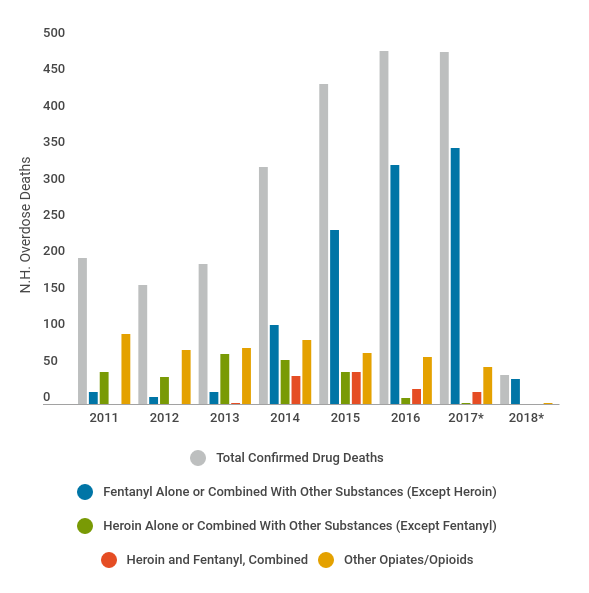
Despite Initial Projections, N.H. Overdose Deaths Didn't Decline in 2017 

Tracking NH Drug Overdose Deaths
April 20, 2018  
        Apr 20, 2018

"New Hampshire politicians criticized President Trump after a transcript of a phone call with the president of Mexico published on Thursday showed he called the state “a drug-infested den.”

The remark came during his comments on the drug trade, criminal gangs and how he said they affected the state, according to a transcript of the Jan. 27 call published by The Washington Post.
“The drug lords in Mexico are knocking the hell out of our country,” Mr. Trump told President Enrique Peña Nieto of Mexico.

“They are sending drugs to Chicago, Los Angeles and to New York,” Mr. Trump continued. “Up in New Hampshire — I won New Hampshire because New Hampshire is a drug-infested den — is coming from the southern border.”

Just FYI Mr. President.  Telling other leaders of countries the only reason you could even possibly win the title and position of Commander and Chief of the United States of America was based on drug addicts, does not speak to highly about you or your own behavior.  But at least the world now knows that it was only caused by people who were clearly not in their right frame of mind.  But your one honest moment of clarity explaining how and why it could even possibly have happened, is greatly appreciated!  So what actions do you plan to take other than pointing fingers and cutting all funding required to help?


Report: Substance Abuse Costing NH Over 2B
By KATHLEEN RONAYNE, Associated Press
May 8, 2017

CONCORD, N.H. (AP) — An advocacy group estimates drug and alcohol abuse cost New Hampshire $2.36 billion in 2014 in lost productivity, health care and strains on the criminal justice system.

A report released by New Futures shows the growing economic toll of the crisis — up more than $50 million from the two previous years — as well as a growth in the number of people seeking treatment under provisions in former President Barack Obama's health care law.

The report also shows that while opioid abuse is increasing, alcohol abuse remains a more significant addiction problem, with more than 110,000 New Hampshire workers experiencing alcohol dependence.

New Hampshire has one of the highest per capita death rates due to drug overdoses in the nation, with nearly 500 people dying from an overdose last year. The report estimates more than 30,000 people in New Hampshire over the age of 15 abused drugs in 2014. New Hampshire is second only to Rhode Island in the percentage of people over age 12 with alcohol and drug dependence, federal data shows.
"There's no price we can place on the lives lost," said Kate Frey, New Futures' director of advocacy.
Most of the $2.36 billion in costs comes from lost worker productivity, estimated at roughly $1.5 billion. Elsewhere, the report finds substance abuse costs the state more than $330 million in health care and more than $306 million in the criminal justice system.

The number of insurance claims for substance abuse treatment in the state jumped from 63,000 in 2012 to 390,000 in 2014, the report shows. And more than 10,000 low-income people on Medicaid expansion have accessed substance abuse treatment since the law took effect.

'Our families are dying' New Hampshires Herion Crisis
NBC News
By Victor Limjco, Daniel A. Medina, and Kate Snow
February 3, 2016

"A Town under Siege
Situated along the I-93 interstate between the state’s two largest cities of Manchester and Nashua, the small town of Londonderry is at the center of a drug-trafficking route where heroin cuts across socio-economic and political lines.

Ed Daniels has worked with the Londonderry Fire Department for 11 years. For most of that time, he says, he saw one or two overdose cases a year. He says he now sees at least one every shift. He says the victims he treats come from all demographics. “There’s no rhyme or reason to it,” said Daniels.
                 
Daniels says the numbers began to spike last summer and have continued to rise, unabated. He blames the increase on fentanyl — an extremely potent pain killer drug that is now commonly cut with heroin to produce a more intense high — and feels, at times, that there is little long-term that he can do for his patients.

"They can leave the hospital," said Daniels. "[But] once they have the addiction, where can they go for help?"

For Londonderry Fire Department Chief Darren O’Brien, who has lived his entire life in Londonderry, “it’s hard to see what’s going on in a community you grew up in.”

O’Brien noted that there were 82 reported overdoses last year — nearly three times the 31 reported cases in 2014. “I’m hoping we can get a handle on it,” he said.

"Our families are dying", A Mother’s Plea for Help

.